Columba, known in Irish as Colum Cille, meaning “Dove of the Church,” became a major figure in the religious and cultural history of Ireland and Scotland. He is associated with founding important monastic centres, spreading Christianity among the Picts, and establishing Iona, which influenced the spiritual life of northern Britain for centuries.
St Columba was born around 521 A D in Gartan, County Donegal, into the Cenél Conaill, a noble branch of the powerful Uí Néill dynasty and this links him to the legendary High King Niall of the Nine Hostages. These claims reflect his elevated status in medieval genealogies. From an early age, Columba received a rigorous religious education. He studied under leading church figures, including Finnian of Movilla and Finnian of Clonard.
Sources describe Columba as a gifted scholar and poet. Three short Latin hymns are later attributed to him, though this remains uncertain. What is clearer is his strong monastic learning and reputation for austerity and spiritual discipline.
Three of the main monastic sites attributed to Columba were Derry, founded around 546 A D, Durrow in County Offaly, founded around 553 A D, and Kells in County Meath, founded around 550 A D. He is best known, however, for building community on the island of Iona in Scotland in 563 A D. Exact dates and details remain uncertain, however Columba’s influence on early Irish monasticism is beyond doubt. In the late seventh century, Adomnán’s Vita Columbae portrays him as a revered abbot and spiritual leader, highlighting his role at Derry and Durrow within a wider religious mission. Adomnán of Iona describes Columba’s departure as a “pilgrimage for Christ.”
By the late sixth century, Iona had become a major centre of Christian learning, spirituality, and missionary activity. Its monks travelled widely to spread the faith, support regional rulers, and establish new religious communities. In time, Iona emerged as one of the most influential monastic centres in the British Isles and played a key role in shaping what is now known as Celtic Christianity.
Columba’s influence extended well beyond his lifetime. In the centuries that followed, he came to be regarded as one of the most important saints in the Gaelic world and was venerated in both Ireland and Scotland as a foundational figure in Christian tradition. His feast day, observed on 9 June, appeared in medieval calendars across Ireland and the British Isles and remains significant in the liturgical year of churches that honour the early Celtic saints. The Book of Kells is linked to Columba’s monastic community; be it was created after his death in 597AD
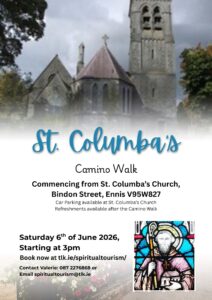
St Columba is one of the three Patron Saints of Ireland so on Saturday 6th June all are welcome to come on a camino walk around Ennis – a town known for its unique streetscape,its Christian learning and caring for its community. We will commence from St Columba Church, Bindon Street at 3pm.
Valerie Raitt
Diocesan Co-Ordinator for Spiritual Tourism & Pilgrimage